

“Our blog gets thousands of views, but is it actually making us money?” It’s the question that keeps business owners awake at night after investing months in content creation.
Here’s the uncomfortable truth: 87% of businesses can’t prove their content marketing generates revenue. They’re creating blog posts, sharing on social media, and hoping for the best – but they have no idea if their content investment is paying off.
At Local Digital Traffic, we’ve developed a systematic approach to measuring content marketing ROI that shows exactly which blog posts drive revenue and which ones waste your time. After helping small businesses optimise their content strategy, we’ve identified the metrics that actually matter for business growth.

The difference between measuring content vanity metrics and actual revenue impact isn’t just academic – it’s the difference between wasting money on content that looks good and investing in content that grows your business.
Why Most Content ROI Measurement Fails
The biggest mistake businesses make is focusing on metrics that feel important but don’t connect to revenue. These “vanity metrics” create a false sense of success while your content budget delivers no real business value.
The Vanity Metrics Trap
Page Views Don’t Equal Profit A blog post with 10,000 views that generates zero leads is less valuable than a post with 500 views that brings in three paying customers. Yet most businesses celebrate the high-traffic post while ignoring the revenue generator.
Social Shares Don’t Pay Bills Getting 100 shares on LinkedIn feels great, but those shares are worthless if they don’t lead to consultation requests or service inquiries. Social engagement often has zero correlation with business results
Time on Page Doesn’t Guarantee Conversions Users might spend five minutes reading your post because it’s entertaining, but never consider hiring you. High engagement without conversion intent is expensive entertainment, not marketing.
The Real Cost of Unmeasured Content
Consider James, a Manchester-based marketing consultant who spent £2,000 monthly on content creation for 18 months. His blog attracted 50,000 monthly visitors and generated thousands of social shares. He felt successful until he realized the content had generated exactly zero new clients.
The hidden costs of unmeasured content include:
- Opportunity cost of focusing on wrong content types
- Budget waste on topics that don’t convert
- Team time spent on ineffective content creation
- Lost revenue from missing high-converting opportunities

After implementing proper ROI measurement, James identified his most valuable content topics and doubled his content-generated revenue within six months while spending 30% less on content creation.
The Revenue-First Content Measurement Framework
Effective content ROI measurement starts with connecting every piece of content to specific business outcomes. Our framework tracks the complete journey from blog post to paying customer.
Setting Up Revenue Attribution
Step 1: Define Your Content Goals: Every blog post should have a specific business objective:
- Lead generation posts aim to capture contact information
- Authority building posts position you as the expert
- Service explanation posts educate prospects about your offerings
- Problem-solution posts attract people ready to buy
Step 2: Create Trackable Conversion Paths: Each content type needs a clear path to revenue:
- Lead generation → Email nurturing → Consultation booking → Sale
- Authority building → Social sharing → Website visit → Service inquiry
- Service explanation → Direct contact → Proposal → Contract
Step 3: Implement Proper Tracking Systems: Use tools that connect content consumption to revenue generation:
- Google Analytics 4 with enhanced e-commerce tracking
- CRM integration to track leads from specific blog posts
- UTM parameters for detailed source attribution
- Call tracking to measure phone-based conversions
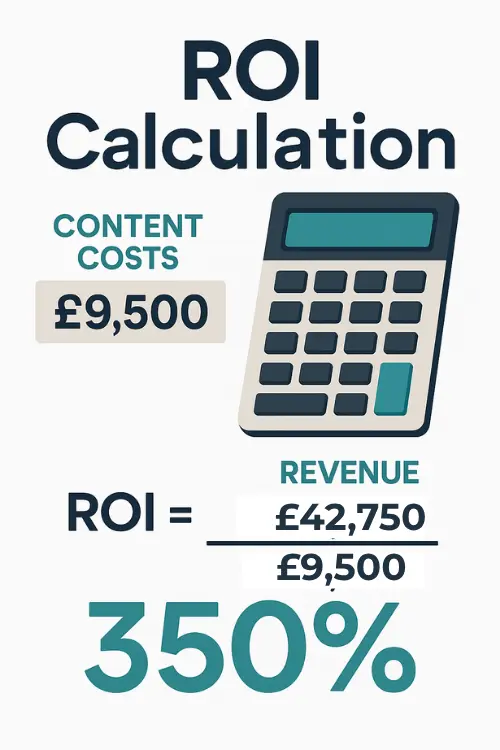
The Content ROI Calculation Formula
Content ROI = (Revenue Attributed to Content – Content Creation Costs) / Content Creation Costs × 100Example Calculation:
- Blog post creation cost: £500
- Revenue attributed to post: £3,000
- ROI = (£3,000 – £500) / £500 × 100 = 500% ROI
Advanced Attribution Modelling: For businesses with longer sales cycles, use weighted attribution:
- First-touch attribution: Credit to the blog post that first attracted the customer
- Last-touch attribution: Credit to the final content piece before purchase
- Multi-touch attribution: Distribute credit across all content touchpoints
Essential Metrics That Actually Matter
Forget vanity metrics. These are the only content marketing metrics that correlate with business growth and revenue generation.
Conversion Rate by Content Type: Track which types of blog posts generate the most leads:
- How-to guides typically convert at 2-4%
- Case studies often achieve 5-8% conversion rates
- Problem-solution posts can reach 8-12%
Lead Quality Scoring: Not all leads are equal, score leads based on:
- Budget qualification (can they afford your services?)
- Timeline urgency (when do they need to buy?)
- Decision-making authority (can they approve purchases?)
- Service fit (do you solve their specific problem?)
Cost Per Lead by Content. Calculate the true cost of acquiring leads through content:
Cost Per Lead = (Content Creation Cost + Promotion Cost) / Number of Qualified LeadsCustomer Lifetime Value from Content: Track the long-term value of customers acquired through specific blog posts. A customer acquired through a technical guide might have a higher lifetime value than one from a general industry post.
Sales Cycle Acceleration Content often shortens sales cycles by pre-educating prospects, measure:
- Average sales cycle length for content-sourced leads
- Comparison to non-content leads
- Content consumption before purchase patterns
Revenue Per Visitor by Content Topic: Identify your most profitable content topics:
Revenue Per Visitor = Total Revenue Attributed / Total Unique Visitors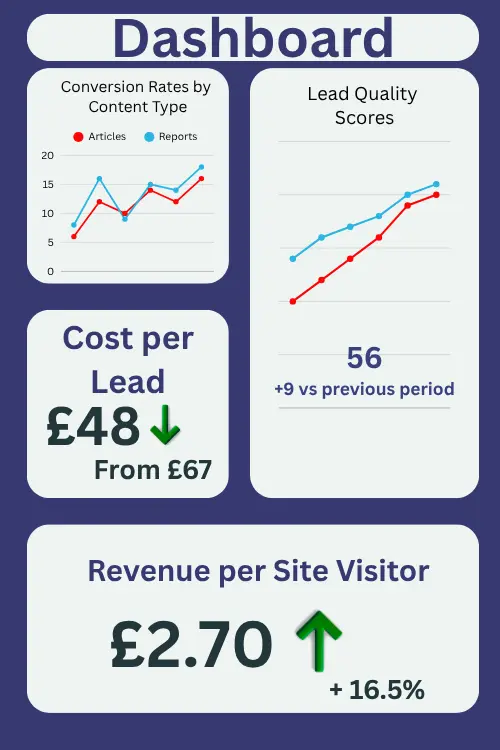
Tools and Systems for Content ROI Tracking
Measuring content ROI requires the right combination of tools working together to provide complete attribution from blog post to bank account.
Google Analytics 4 Setup Configure GA4 for content attribution:
- Enhanced e-commerce tracking for revenue attribution
- Custom goals for each content conversion type
- Attribution models to understand content impact
- Audience segments based on content consumption
CRM Integration Connect your content to customer records:
- HubSpot for comprehensive content tracking
- Pipedrive for simple content-to-deal attribution
- Custom solutions for specific business needs
Heat Mapping and User Behavior: Understand how users interact with your content:
- Hotjar for scroll depth and click tracking
- Crazy Egg for visual user behavior analysis
- Microsoft Clarity for free session recordings
Advanced Attribution Systems
UTM Parameter Strategy Create consistent UTM tracking for all content promotion:
- Source: Where traffic comes from (organic, social, email)
- Medium: How they found it (search, post, newsletter)
- Campaign: Specific content piece or topic
- Content: Specific CTA or link clicked
Call Tracking Integration Many B2B sales happen via phone calls triggered by blog posts:
- Dynamic number insertion for content pages
- Call recording to understand conversion quality
- Revenue attribution to specific blog posts
Marketing Automation Track the complete customer journey:
- Email sequences triggered by blog post consumption
- Lead scoring based on content engagement
- Automated follow-up for high-value content visitors
Content ROI Analysis and Optimisation
Once you’re collecting revenue data, the real work begins: analysing performance and optimising your content strategy for maximum ROI.
Identifying High-Performing Content
Revenue Analysis by Content Topic After three months of tracking, analyse which topics generate the most revenue:
- Technical guides often attract ready-to-buy prospects
- Case studies build trust and credibility
- Problem-solution posts capture high-intent searchers
- Industry insights position you as the expert
Content Format Performance: Different formats appeal to different buyer stages:
- Long-form guides (2,000+ words) often generate higher-quality leads
- Video content can increase conversion rates by 20-30%
- Infographics drive social sharing but may have lower conversion rates
- Case studies typically have the highest lead-to-customer conversion rates
Seasonal and Timing Optimisation Track when your content performs best:
- Publication timing impact on initial traffic
- Seasonal trends in your industry
- Content lifecycle performance over time
Optimising Low-Performing Content
Content Refresh Strategy: Instead of creating new content, optimise existing posts:
- Update statistics and examples for relevance
- Improve conversion elements (CTAs, forms, offers)
- Add internal linking to higher-converting content
- Enhance SEO optimisation for better organic reach
Conversion Rate Optimisation Small changes can dramatically improve content ROI:
- Test different CTAs throughout the post
- Optimise form placement and field requirements
- Improve page loading speed for a better user experience – our guide explains why achieving 90+ page load speed scores matters
- Add trust signals like testimonials and certifications

Common Content ROI Measurement Mistakes
After analysing numerous content marketing campaigns, we’ve identified the most common mistakes that sabotage accurate ROI measurement.
Attribution Errors
Single-Touch Attribution Bias Many businesses only credit the last content piece before purchase, ignoring the nurturing effect of earlier blog posts. A prospect might read five blog posts over three months before making contact, but single-touch attribution only credits the final post.
Ignoring Offline Conversions Content often influences phone calls, in-person meetings, and referrals that don’t show up in digital analytics. Without call tracking and offline attribution, you’re missing significant content ROI.
Short Attribution Windows B2B sales cycles often span 6-18 months. Using 30-day attribution windows severely undervalues content that starts long nurturing processes.
Measurement Implementation Problems
Incomplete Tracking Setup Common setup errors include:
- Missing conversion goals in Google Analytics
- Broken UTM parameter tracking
- Unconnected CRM systems
- No phone call attribution
Data Quality Issues: Poor data quality leads to wrong decisions:
- Bot traffic inflating visitor numbers
- Internal team visits skewing analytics
- Duplicate customer records in CRM systems
- Inconsistent lead scoring criteria
Industry-Specific Content ROI Benchmarks
Content ROI varies significantly by industry and business model. Understanding realistic benchmarks helps set appropriate expectations and identify optimisation opportunities.
Service-Based Business Benchmarks
Professional Services (Legal, Accounting, Consulting)
- Average content marketing ROI: 300-500%
- Typical cost per lead: £50-£200
- Lead-to-customer conversion rate: 15-25%
- Average customer lifetime value from content: £5,000-£50,000
Home Services (Plumbing, HVAC, Electrical)
- Average content marketing ROI: 200-400%
- Typical cost per lead: £20-£80
- Lead-to-customer conversion rate: 25-40%
- Average customer lifetime value from content: £500-£2,000
Digital Marketing Agencies
- Average content marketing ROI: 400-800%
- Typical cost per lead: £30-£150
- Lead-to-customer conversion rate: 10-20%
- Average customer lifetime value from content: £2,000-£20,000
Content Performance by Business Stage
Startup Businesses (0-2 years) Focus on lead generation and brand awareness:
- Priority metrics: Lead volume and cost per lead
- Expected ROI timeline: 6-12 months
- Content budget allocation: 60% creation, 40% promotion
Established Businesses (3+ years) Optimise for customer lifetime value and market share:
- Priority metrics: Customer acquisition cost and lifetime value
- Expected ROI timeline: 3-6 months
- Content budget allocation: 40% creation, 60% optimisation and promotion
Building a Content ROI Culture
Sustainable content ROI improvement requires changing how your entire team thinks about content creation and measurement.
Team Education and Buy-In
Training Your Content Team: Everyone involved in content creation should understand:
- Business objectives behind each content piece
- Target audience and their buying journey stage
- Conversion goals and success metrics
- ROI calculation methods and importance
Regular Performance Reviews Schedule monthly content ROI reviews:
- Performance analysis of published content
- Strategy adjustments based on data
- Resource allocation to highest-ROI activities
- Team feedback and improvement suggestions
Continuous Improvement Process
Monthly ROI Analysis Track these key questions:
- Which content pieces generated the most revenue?
- What topics consistently outperform others?
- How has content ROI trended over time?
- Where should we invest additional resources?
Quarterly Strategy Optimisation Use ROI data to refine your content strategy:
- Double down on high-performing content types
- Eliminate or refresh low-performing content
- Test new formats and topics systematically
- Adjust budget allocation based on ROI performance
Getting Started with Content ROI Measurement
Ready to transform your content marketing from expense to profit centre? Here’s your step-by-step implementation plan.
30-Day Quick Start Plan
Week 1: Foundation Setup
- Install Google Analytics 4
- Set up basic conversion goals for your website
- Create UTM parameter templates for content promotion
- Audit existing content for conversion opportunities
Week 2: CRM Integration
- Connect your CRM to website analytics
- Create lead sources for different content types
- Set up automated lead scoring based on content consumption
- Train the team on proper lead attribution
Week 3: Content Audit and Optimisation
- Analyse existing content performance
- Identify your top 10 most-visited blog posts
- Add conversion elements to high-traffic content
- Create content upgrade offers for lead generation
Week 4: Measurement and Analysis
- Review first month of ROI data
- Identify patterns in high-converting content
- Plan next month’s content based on performance
- Set ROI targets for new content pieces
90-Day Optimisation Timeline
Month 1: Data Collection: Focus on accurate tracking setup and initial data gathering without making major strategy changes.
Month 2: Analysis and Insights: Identify patterns, optimise existing content, and begin creating new content based on performance insights.
Month 3: Strategy Refinement: Double down on successful approaches while eliminating or refreshing underperforming content.
Professional Content ROI Optimisation
While basic content ROI measurement is possible with free tools, comprehensive optimisation requires expertise and sophisticated systems.
When to Invest in Professional Help
Complex Attribution Requirements: If your business has long sales cycles, multiple touchpoints, or complex customer journeys, professional attribution modelling can unlock significant ROI improvements.
Advanced Analytics Setup: Custom tracking implementations such as Google Analytics, advanced segmentation, and sophisticated reporting often require technical expertise to implement correctly.
Strategy Development and Optimisation: Understanding what the data means and how to act on it often requires experienced content strategists who’ve optimised campaigns across multiple industries.
What Professional Content Strategy Includes
Comprehensive ROI Audit
- Current tracking system analysis
- Attribution model optimisation
- Revenue opportunity identification
- ROI improvement roadmap
Advanced Measurement Implementation
- Custom analytics configuration
- CRM integration and automation
- Advanced attribution modelling
- Performance dashboard creation
Ongoing Strategy Optimisation
- Monthly performance analysis
- Content strategy refinement
- ROI-based budget allocation
- Team training and support
Start Measuring Your Content ROI Today
Content marketing without ROI measurement is just expensive guesswork. Every day you create content without tracking its revenue impact is another day of potentially wasted budget and missed opportunities.
The businesses that will dominate their markets are those that can prove their content generates revenue – and optimise based on that data. While competitors create content based on hunches, you’ll be creating content based on proven ROI performance.
Ready to transform your content marketing from a cost centre to a profit driver?
Our comprehensive content strategy service includes complete ROI measurement setup, ongoing optimisation, and monthly performance analysis. We’ll help you identify which content drives revenue, eliminate what doesn’t work, and scale what does.
Get started with a free consultation. Then, we’ll analyse your current content performance, identify missed revenue opportunities, and show you exactly how proper measurement could impact your business results.
Don’t let another month of content investment go unmeasured. Contact us today to discover how content ROI tracking can transform your marketing results.
Ready to prove your content marketing ROI? Our content strategy service includes comprehensive ROI tracking, performance optimisation, and revenue attribution analysis. Book your free consultation to see how data-driven content strategy can grow your business.
